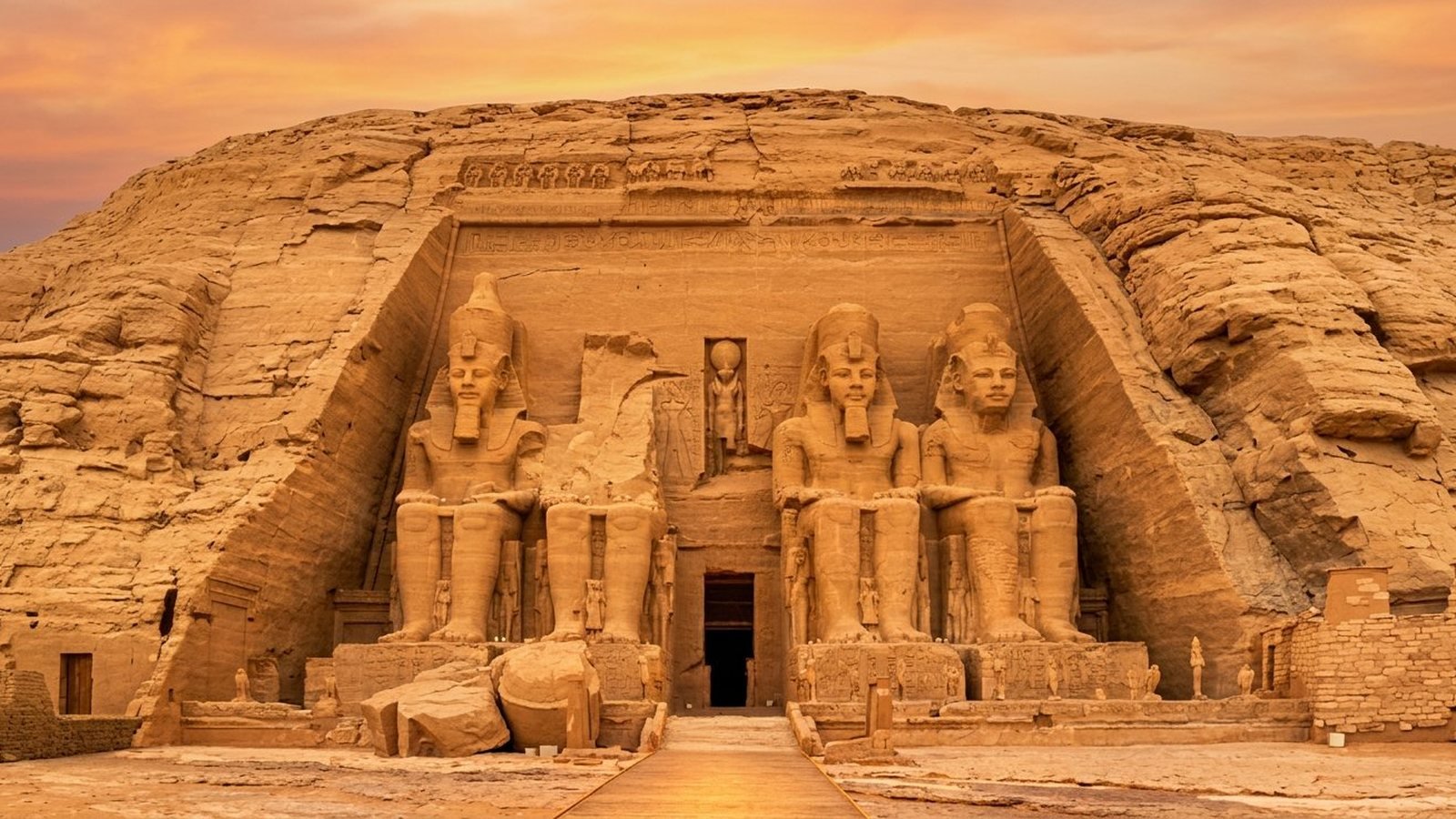
Twice a year, in the dark hours before sunrise, a small crowd gathers outside the Great Temple of Abu Simbel and waits. There is no show, no lighting rig, nothing mechanical at all. What they are waiting for was engineered more than 3,200 years ago: a single shaft of sunlight that travels 60 meters through a rock-cut corridor to land, for a few minutes, directly on the face of a statue of Ramesses II.
It happens on 22 February and 22 October every year, and it is one of the very few pieces of ancient engineering still performing exactly as designed, on schedule, without restoration or adjustment.
What the Sun Festival Actually Is
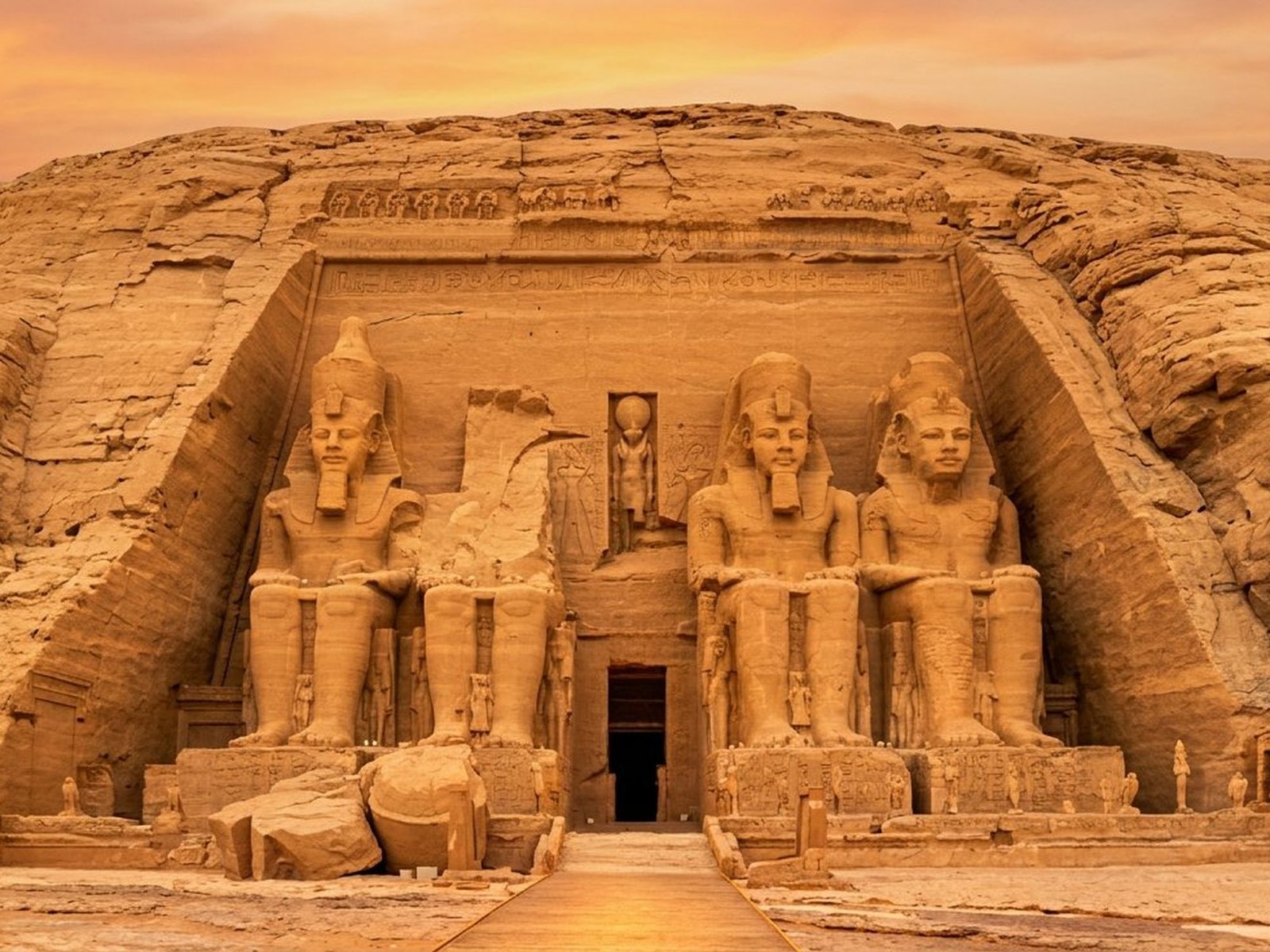
The Great Temple of Abu Simbel was carved directly into a sandstone cliff on the orders of Ramesses II, roughly 1264 BC, and its inner sanctuary sits 60 meters back from the entrance, carved deep into the mountain itself. Inside that sanctuary sit four seated statues: Ramesses II himself, flanked by the gods Ra-Horakhty, Amun, and Ptah.
For 363 days of the year, that sanctuary stays in total darkness. On 22 February and 22 October, the sun rises at precisely the angle needed to send a beam straight down the temple's central axis, through the entrance, the hypostyle hall, and the second chamber, until it reaches the back wall and illuminates three of the four statues — Ramesses, Ra-Horakhty, and Amun. Ptah, god of the underworld, stays in shadow by design; he was never meant to be touched by sunlight.
Why Those Two Dates, and What They Mean
The two alignment dates are widely believed to mark Ramesses II's coronation day and his birthday, turning the temple itself into a kind of calendar — one built from solid rock, oriented with a precision that modern surveying only confirmed centuries later. There is no inscription that states this outright, and Egyptologists still debate the exact intention, but the dates are close enough to the pharaoh's known reign dates that the theory has held up for over a century of study.
What is not in question is the engineering itself. Cutting a 60-meter corridor through sandstone and aligning it to within a fraction of a degree, using tools that predate the compass, the telescope, and precision surveying instruments by millennia, remains one of the clearest demonstrations of how advanced ancient Egyptian astronomy and construction really were.
See the Alignment in Person
The Sun Festival window is narrow and the site fills up early. Egypt Sun Travel runs a dedicated pre-dawn departure built entirely around getting you inside the temple before first light, with pickup options from Aswan, Luxor, and Cairo.
The 1960s Relocation That Almost Broke the Alignment
In the 1960s, the construction of the Aswan High Dam threatened to submerge Abu Simbel entirely under the rising waters of Lake Nasser. In one of the largest archaeological rescue operations in history, UNESCO coordinated the cutting of both temples into more than 1,000 blocks, each weighing up to 30 tons, and reassembled them 65 meters higher and 200 meters back from the original site.
Engineers went to considerable lengths to preserve the solar alignment during that move, and they came extremely close: the sunlight still reaches the sanctuary on the same two dates, though the exact moment shifted by about a day compared to the original ancient alignment. It remains one of the only relocated monuments in the world where an astronomical function this precise survived the move at all.
What Actually Happens on the Day
Visitors gather outside the temple well before sunrise, since the beam itself only lasts around 20 minutes before the angle shifts away from the sanctuary. The site is at its most crowded on these two mornings of the year, with a festive atmosphere that includes music, dancing, and a noticeably different energy from a typical daytime visit. Arriving early is not optional if you want a clear view of the inner sanctuary at the right moment.
Because Abu Simbel sits roughly 280 kilometers south of Aswan, near the border with Sudan, reaching it for a pre-dawn event means leaving your hotel in the middle of the night. It is a long journey for a short, unrepeatable moment — which is exactly why most visitors choose to do it as an organized departure rather than arranging transport independently at 2 a.m.
Planning a Visit Around the Festival
Most travelers see Abu Simbel on an ordinary day trip from Aswan, which still shows the temples in full daylight but without the sanctuary illumination. Timing a visit specifically around 22 February or 22 October is the only way to see the alignment itself, and because the date is fixed and well known, accommodation and transport in Aswan can book up well ahead of each date.
The practical options are a pre-dawn departure from Aswan itself, a longer transfer from Luxor, or a full day trip down from Cairo — each with a very different drive time, since Abu Simbel is roughly 3 hours from Aswan but considerably farther from either Luxor or Cairo. Whichever city you start from, the alignment does not wait: the beam moves on in minutes, which makes an organized departure with a guide who knows the exact sightline worth the early wake-up call.