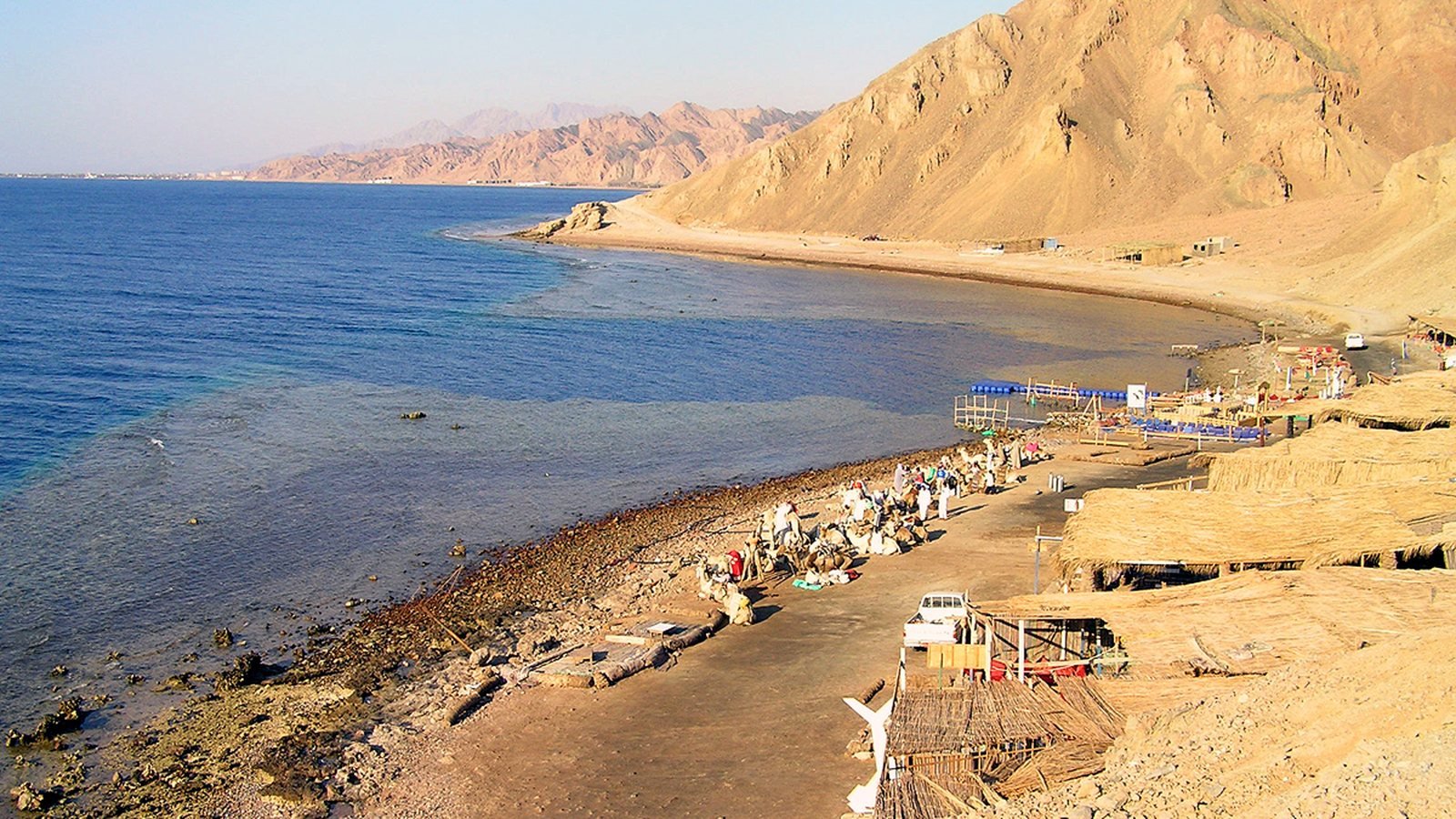
Most visitors to Egypt picture temples and sand the color of bone. Sinai has a way of rearranging that picture. Within an hour of each other sit two landscapes that feel like they belong to different planets: a narrow sandstone corridor near Nuweiba striped in reds, purples, and ochres, and a near-perfect circle of water off the coast at Dahab that drops straight down for more than a hundred meters. Neither is a monument built by people. Both were built by geology, water, and time, and both have become essential stops for anyone making their way along Sinai's eastern coast.
The Colored Canyon and the Blue Hole get mentioned together constantly in trip itineraries, mostly because they sit within easy reach of the same base — the town of Dahab, a former Bedouin fishing village turned relaxed diving hub that still feels unhurried compared to the resort density of Sharm El Sheikh an hour or so south. What the itineraries don't always explain is why these two places, so different in character, both reward genuine attention rather than a rushed photo stop.
A Canyon Carved by Flash Floods, Not Rivers
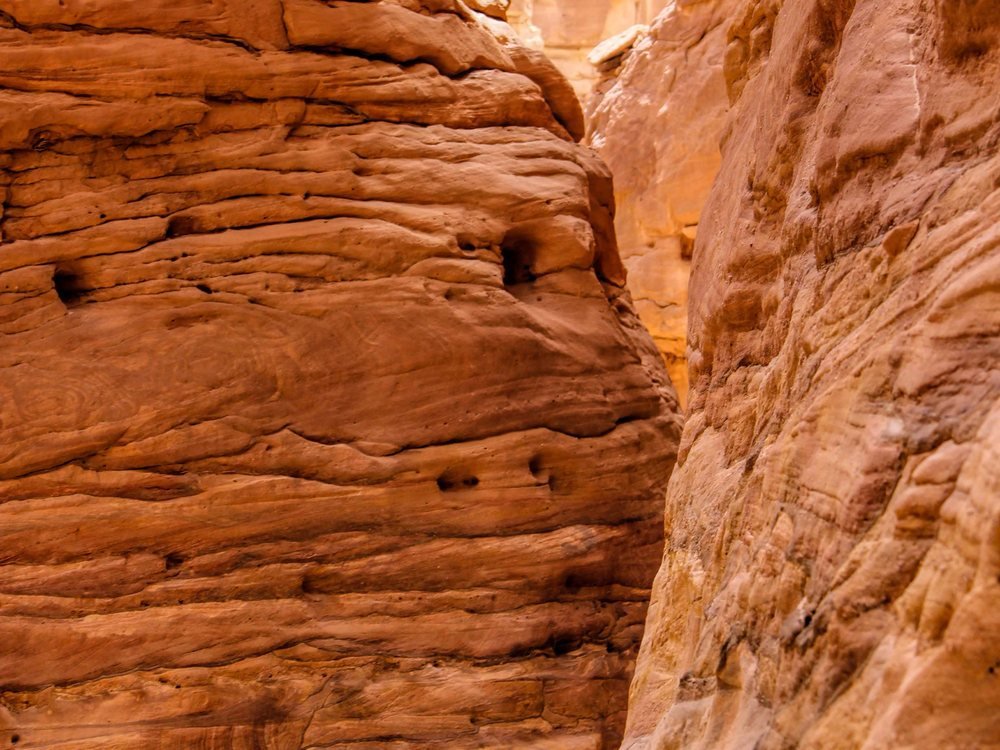
The Colored Canyon is a slot canyon roughly 800 meters long, with walls that in places rise 40 meters overhead while the passage between them narrows to barely a shoulder's width. It was not cut slowly by a river the way the Grand Canyon was. The sandstone here was laid down as seabed sediment some 30 to 50 million years ago, then lifted by the same tectonic rifting that opened the Gulf of Aqaba and the Red Sea. What actually carved the canyon's twisting shape was centuries of flash floods, rare but violent desert downpours exploiting a fault line in the rock and gradually widening a crack into a corridor.
That violent origin is also what explains the color. The banding running through the rock — rust red, deep purple, bleached white, mustard yellow — comes from different minerals deposited in the sandstone over different geological periods: iron oxide for the reds and oranges, manganese for the darker purples and blacks, silica and calcium carbonate for the paler bands. Walking through feels less like hiking and more like moving through a cross-section of deep time, with each color a different chapter.
Dahab: The Town That Grew Up Around the Diving
Dahab itself is worth pausing on before getting to the Blue Hole, because the town's character shapes how the dive site is experienced. Once a quiet Bedouin fishing settlement on the Gulf of Aqaba, it developed in the 1980s and 90s into a backpacker and diving destination with a distinctly different pace than Egypt's larger resort towns — low-rise buildings, beachfront cafes with cushions instead of chairs, and a promenade, the Lighthouse and Mashraba areas, built almost entirely around the business of getting people into the water.
That history matters because the Blue Hole sits just a short drive north of town, close enough that it functions as a half-day outing rather than an expedition. Snorkelers, first-time divers, and people who simply want to look over the reef edge all show up alongside the technical diving community the site is best known for among specialists worldwide.
See Both in a Single Day
The Colored Canyon and the Blue Hole sit close enough together that a single day trip covers both comfortably — a scramble through striped sandstone in the morning, then an afternoon by the most famous reef in the Red Sea. This Egypt Sun Travel tour handles the transport and timing so you just show up.
The Blue Hole: A Sinkhole 130 Meters Deep
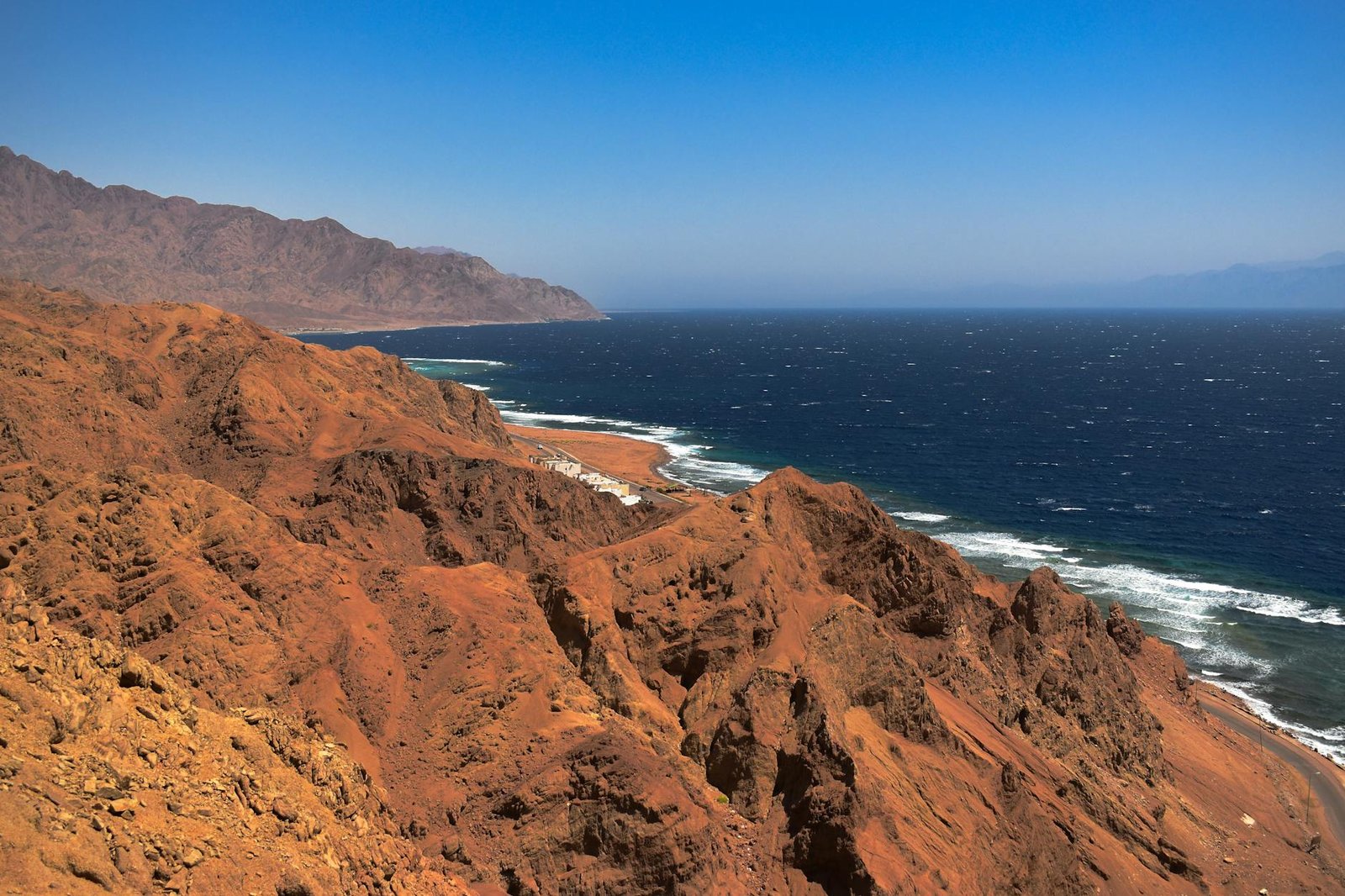
The Blue Hole is a near-circular submarine sinkhole roughly 60 meters across at the surface, ringed by a shallow reef that rises to within a meter or two of the surface — close enough that visitors can stand at the edge and look straight down into water that shifts from turquoise to a deep, saturated blue as the floor drops away beneath them. At its deepest, the hole reaches around 130 meters, and it connects to the open sea through a natural tunnel known as the Arch, whose ceiling sits at about 55 meters depth.
For recreational divers and snorkelers, the Blue Hole's appeal is straightforward: clear, warm Red Sea water, healthy coral around the rim, and a dramatic wall that drops away into blue instead of the usual gradual slope. The surface area and the shallow reef edge are a completely different activity from what happens deeper down, and the vast majority of visitors who come for a swim, a snorkel, or a recreational dive within normal depth limits experience nothing more than a strikingly beautiful reef.
The Arch, and an Honest Word on the Site's Reputation
It would be incomplete to write about the Blue Hole without acknowledging why it carries a heavier reputation among divers than most Red Sea sites. The Arch — the tunnel connecting the Hole to open water at 55 meters — has drawn technical and sometimes under-prepared divers attempting to swim through it as a personal challenge, since it sits well beyond the roughly 40-meter limit generally observed in recreational diving. Over the decades, the site has recorded a disproportionate number of diving fatalities, nearly all of them tied to divers attempting the Arch without the trimix training, gas planning, and certification the passage actually requires.
Egyptian diving authorities have responded accordingly: a Tec 60 certification minimum is required for attempts on the Arch, and a safety officer is stationed at the site to confirm divers are working with a certified guide. None of this bears on the ordinary visitor experience. Snorkeling the rim, diving the reef wall within recreational limits, or simply walking out to look over the edge are routine, well-supervised activities enjoyed by thousands of visitors a year without incident — the same way a popular mountain's summit route can be genuinely dangerous for climbers chasing a technical record while its lower trails remain a safe afternoon walk for everyone else.
Two Landscapes, One Afternoon
What makes the pairing of Colored Canyon and Blue Hole work as a single outing isn't just geography, though the proximity helps — it's the contrast. One is a dry, narrow, mineral-striped passage you move through on foot, shaped by rare violent floods over tens of millions of years. The other is a near-bottomless pool of blue water you look down into from a reef's edge, shaped by the same tectonic forces that cracked open the Red Sea itself. Seeing both in the same day gives a more complete sense of how Sinai's landscape actually formed than either one does alone.
Sinai rarely gets the same attention as the Nile Valley or Cairo's antiquities in a first-time visitor's itinerary, but it holds a different kind of Egyptian story — one written in rock strata and coral rather than hieroglyphs, and best understood by actually standing inside the canyon or looking over the reef, rather than reading about either from a distance.