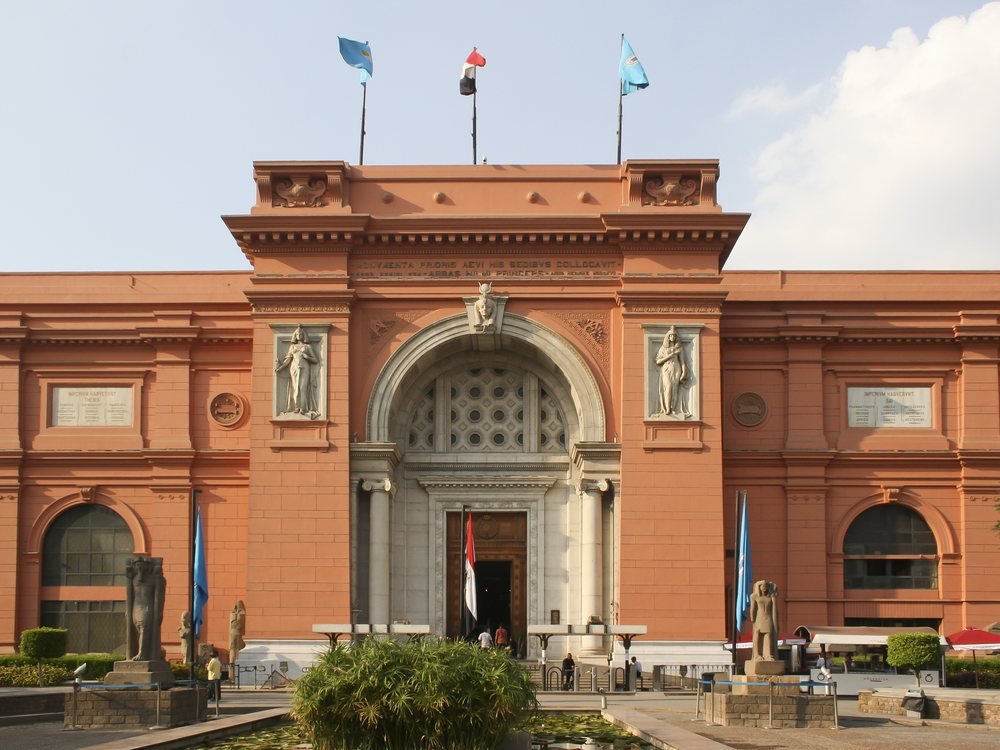
For most of the last century, there was only one address in Egypt where you went to stand in front of Tutankhamun's gold. It was a salmon-pink building on Tahrir Square in downtown Cairo, built in 1902, with wooden cabinets, hand-lettered labels, and a density of antiquities so overwhelming that first-time visitors often left remembering almost nothing specific at all. For well over a hundred years, that was simply what seeing ancient Egypt's treasures meant.
That changed on November 1, 2025, when the Grand Egyptian Museum opened its full galleries on the Giza plateau, a few kilometers from the Pyramids themselves. For the first time since Howard Carter pulled the boy king's tomb out of the Valley of the Kings in 1922, the complete Tutankhamun collection — all 5,398 objects, from the solid gold death mask down to the linen underwear buried with him — is displayed together in one place. The story of how Egypt got from that cramped downtown building to this one is really the story of the country trying to finally tell its own history on its own terms.
A Museum Large Enough to Need Its Own Climate
The numbers around the Grand Egyptian Museum get repeated so often they start to sound like marketing, but they hold up. The site covers roughly 500,000 square meters — about seven times the exhibition space of the old Tahrir museum and close to four times that of the Louvre — and holds more than 100,000 artifacts spanning seven millennia, from predynastic pottery to the Greek and Roman periods that followed the pharaohs. It took close to two decades to build, delayed repeatedly by funding gaps, a revolution, and a pandemic, which is part of why GEM Cairo's opening felt less like a ribbon-cutting and more like the end of a very long national project.
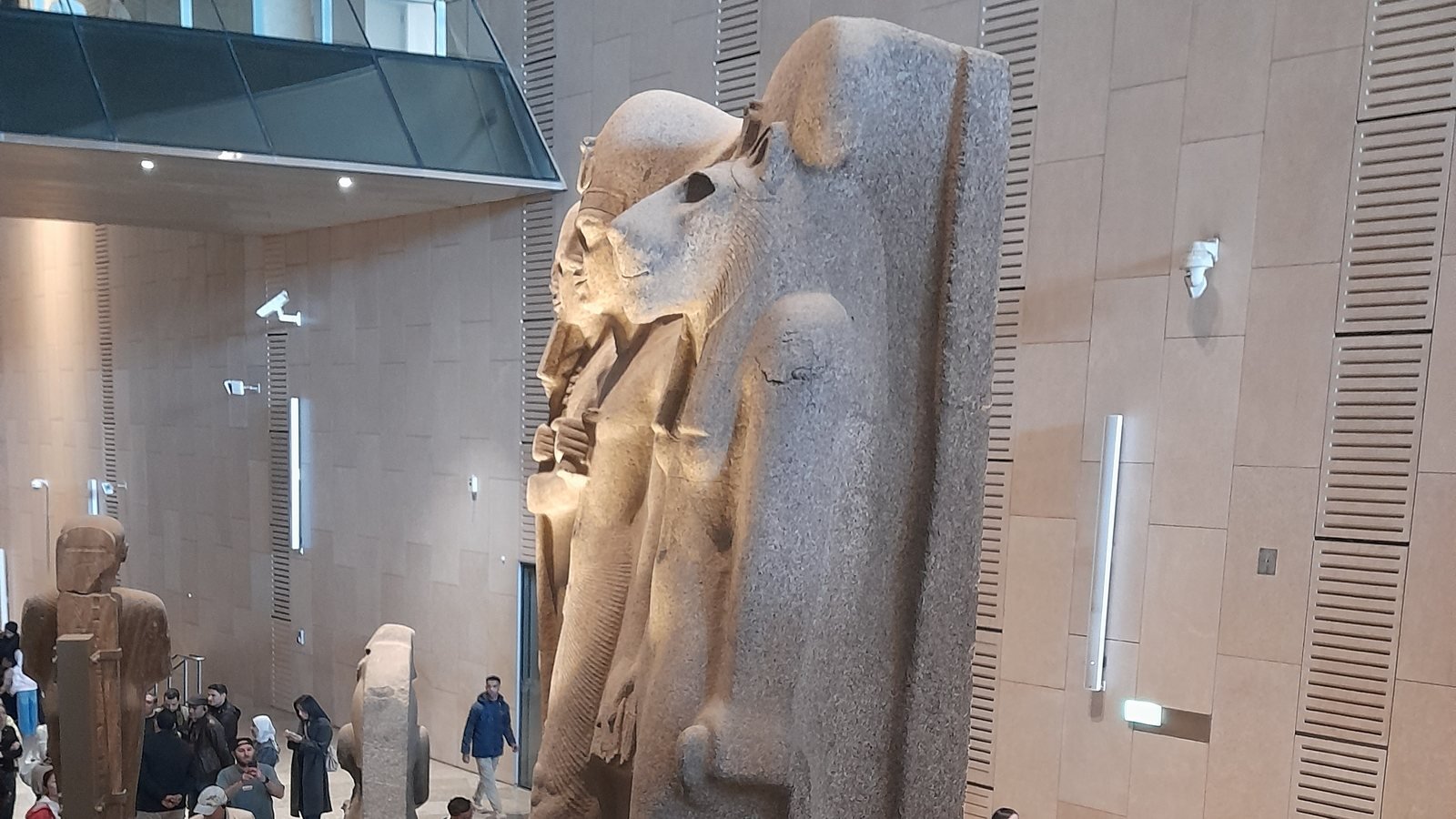
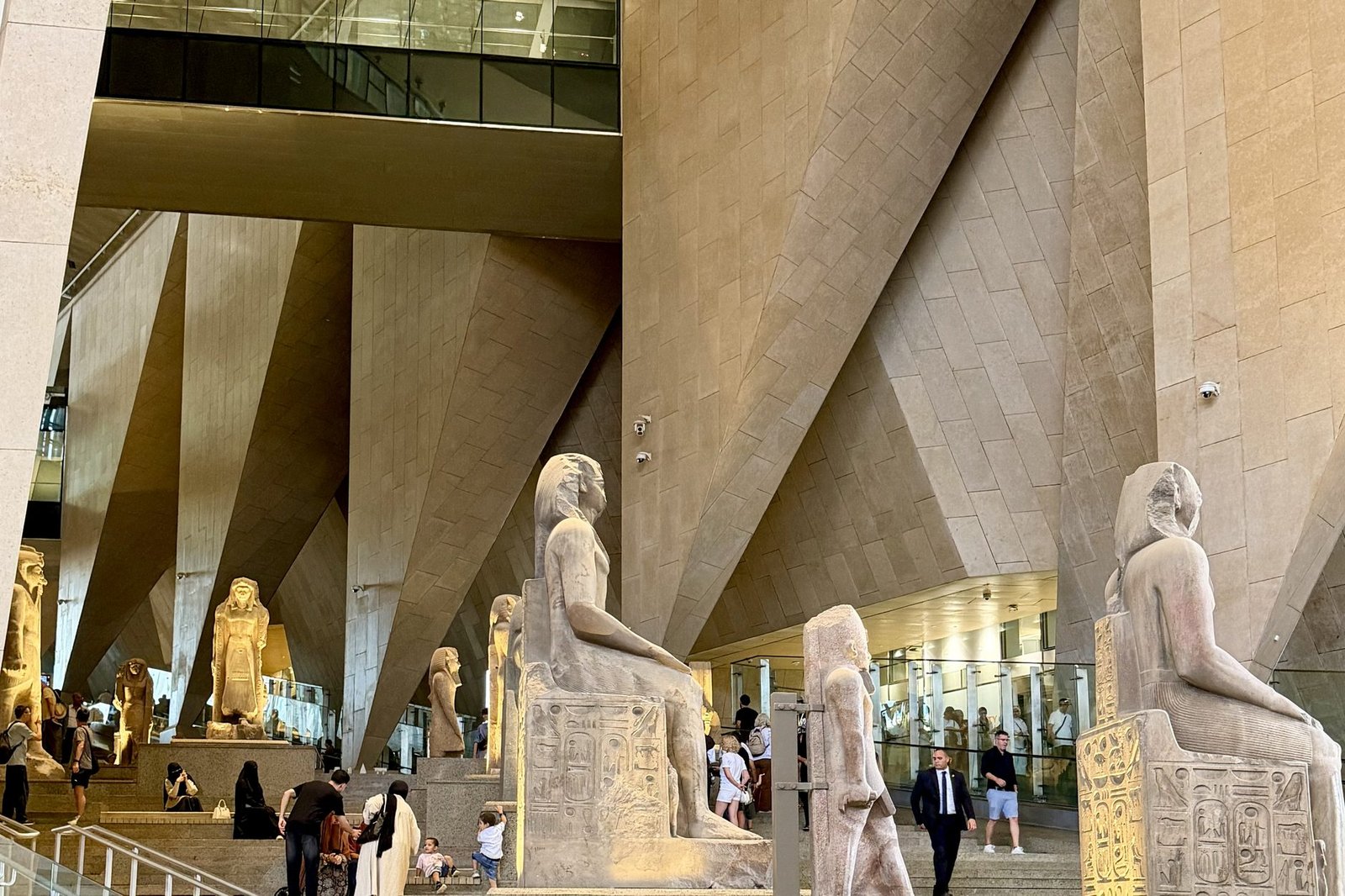
Walking in, visitors first encounter the Grand Hall and the Grand Staircase — not a single flight of stairs but a monumental six-story ascent lined with dozens of colossal statues, among them a towering granite figure of Ramesses II originally moved here from a Cairo traffic circle in a logistical operation that made headlines on its own. Climb it slowly and the Giza Pyramids appear through the glass at the top, timed so that the oldest wonder in the museum and the oldest wonder outside it sit in the same sightline.
Tutankhamun, Finally Whole
The Tutankhamun galleries are the reason most people are now searching for Grand Egyptian Museum tickets in the first place, and they earn the attention. Howard Carter's 1922 discovery produced over 5,000 objects, but for a century they were scattered — some on permanent display in Tahrir, others in storage, a few on loan abroad for decades at a stretch. GEM is the first time the entire find has been reassembled under one roof, arranged in the sequence Carter encountered them: the outer shrines, the nested coffins, the jewelry, the chariots, the beds shaped like guardian animals, and finally the golden mask itself, now the center of a dedicated hall built specifically around it.
Nearby, in its own pavilion, sits Khufu's solar boat — a 4,600-year-old cedar vessel found disassembled in a pit beside the Great Pyramid in 1954 and painstakingly reconstructed, plank by plank, without a single nail. It is one of the oldest intact wooden boats on Earth, and GEM finally gives it a space tall enough to display it as a whole ship rather than a curiosity folded into a corner.
See Both Museums for Yourself
Reading about the Grand Staircase and the old halls of Tahrir is one thing; walking between them with someone who can explain what you're looking at is another. These Egypt Sun Travel tours cover both.
So Why Is the Old Museum Still Open?
This is the question nearly every traveler planning a Cairo trip eventually asks, and the honest answer is that the two museums were never meant to simply replace one another. Egypt's Ministry of Tourism and Antiquities confirmed in early 2026 that the Tahrir museum will remain open to the public at least through 2030, and likely well beyond. It still holds the Royal Mummies Hall's neighboring galleries of coffins, jewelry, and funerary art that GEM has not absorbed, along with a particular kind of old-world atmosphere — dim lighting, crowded glass cases, a sense of discovery rather than curation — that some visitors, and more than a few Egyptologists, genuinely prefer.
The comparison people most often ask about, Egyptian Museum Cairo vs GEM, usually misses the point that this isn't really a competition. Tahrir is a 123-year-old institution with its own history as an artifact in its own right — one of the first purpose-built museums in the Middle East, designed by a French architect at a time when Egypt was still negotiating who got to tell its own story. GEM is something else: a 21st-century answer to a question Egypt has been asking since Carter's discovery made Tutankhamun a global name — namely, where should the most significant archaeological find in modern history actually live.
Visiting Both: What Actually Changes Day to Day
Practically, visiting GEM today looks different from visiting any Egyptian museum before it. Since December 2025, all Grand Egyptian Museum tickets are sold online in advance through timed entry slots rather than at the gate, a shift driven by the sheer volume of demand following the opening. Foreign adult admission runs around $30, covering the main galleries, the Tutankhamun collection, and the Solar Boat Pavilion under a single ticket, with a scheduled increase to $35 planned for November 2026. Bring a passport — ID verification is now standard at entry.
The practical version of the Tutankhamun treasures museum question, then, isn't really which one to choose. Most travelers with more than a single day in Cairo end up doing both: GEM for the scale, the full Tutankhamun collection, and the view of the Pyramids from the Grand Staircase; Tahrir for the older rooms, the royal mummies in their own dedicated hall nearby, and a sense of how Egyptology itself has evolved over more than a century of discovery.
What the New Museum Is Really About
It's tempting to read the Grand Egyptian Museum purely as an engineering story — the size, the cost, the decades of delay — but the more interesting shift is quieter than that. For the first time, the single most famous discovery in the history of archaeology is being presented whole, in the country where it was found, a few miles from the pyramids its builders might have still recognized. The old museum in Tahrir isn't a relic being phased out; it's the first chapter of a story that GEM now lets you finish in the same afternoon, which is about as neat a metaphor for modern Egypt — standing between its ancient past and its own unfinished present — as any single building is likely to offer a visitor.