For roughly five hundred years, Egypt's New Kingdom pharaohs stopped building pyramids. Not because they ran out of ambition, but because pyramids were, from a practical standpoint, enormous advertisements for tomb robbers — a giant stone arrow pointed at a chamber full of gold. So starting around 1539 BCE, Egypt's rulers switched strategies entirely: they carved their tombs directly into the limestone cliffs of a narrow, easily guarded desert valley on the West Bank of the Nile at Thebes, hid the entrances, and hoped obscurity would do what monumental scale could not.
It worked for a while. More than sixty tombs have been identified in the Valley of the Kings since excavation began in earnest in the 19th century, and new chambers are still occasionally found. Walking down into one today — down a sloped corridor, past guardian figures painted directly onto rock that has never seen direct sunlight — is a different kind of encounter with ancient Egypt than looking at a pyramid from outside. You are not admiring a monument. You are inside someone's actual burial.
The Tomb That Almost Wasn't Found
Of all the tombs in the Valley of the Kings, one changed the field of Egyptology more than any other, and it belongs to a minor, short-lived king who died around the age of nineteen. On November 4, 1922, after six seasons of fruitless digging and a patron close to pulling his funding entirely, archaeologist Howard Carter's workmen uncovered a buried step beneath debris near the entrance of KV9. Three weeks later, Carter and Lord Carnarvon broke through a sealed doorway and, holding a candle to a small gap, saw — in Carter's own words — 'wonderful things.'
Tutankhamun's tomb is famous for one reason above all others: almost every other tomb in the Valley had already been emptied by robbers, in some cases within decades of the burial itself. Tutankhamun's was not. Carter spent nearly a decade cataloguing several thousand objects crammed into four modest rooms — golden shrines nested inside one another, chariots, furniture, the boy king's own linen underwear — most of which had sat untouched for over three thousand years. The wall paintings inside are actually more restrained than those in larger royal tombs nearby, a reminder that Tutankhamun's fame rests on what survived around him, not on the scale of the tomb itself.
Hatshepsut's Temple: Architecture Built to Outlast an Erasure
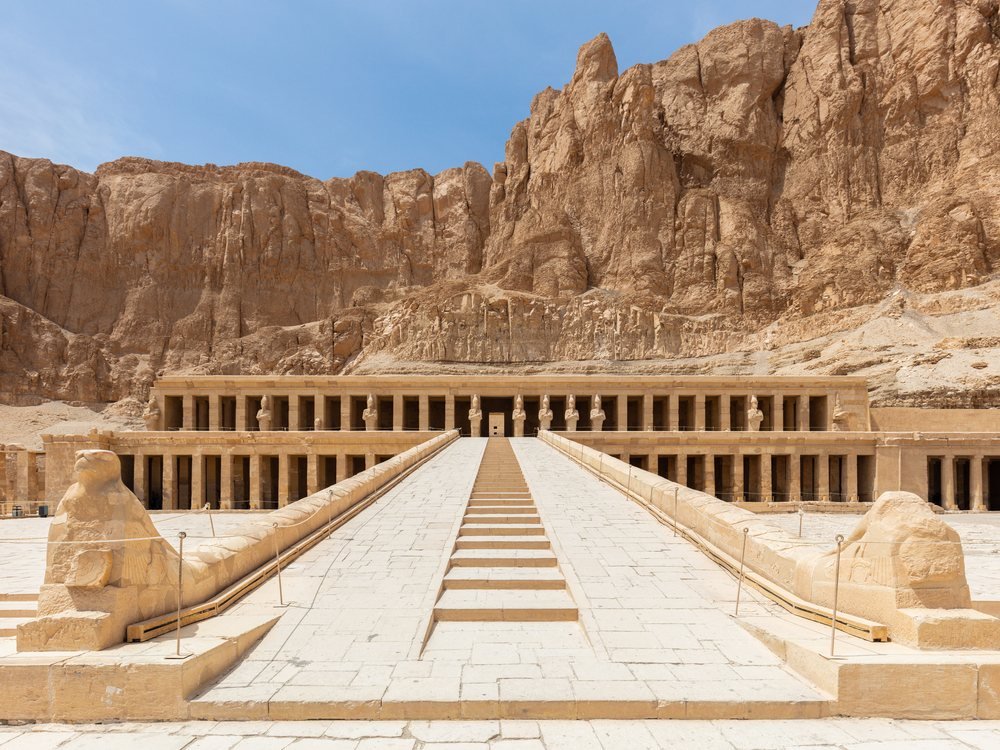
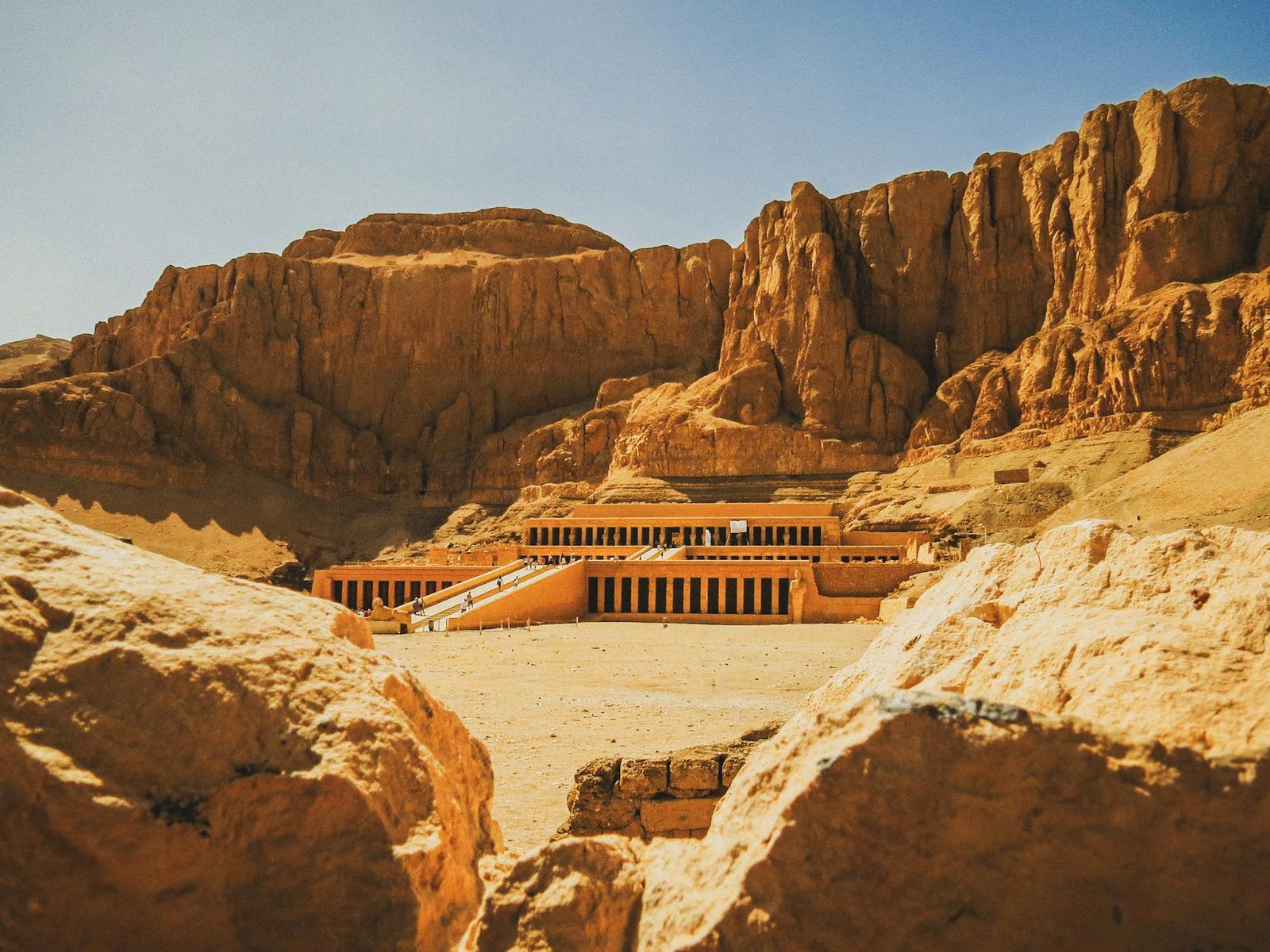
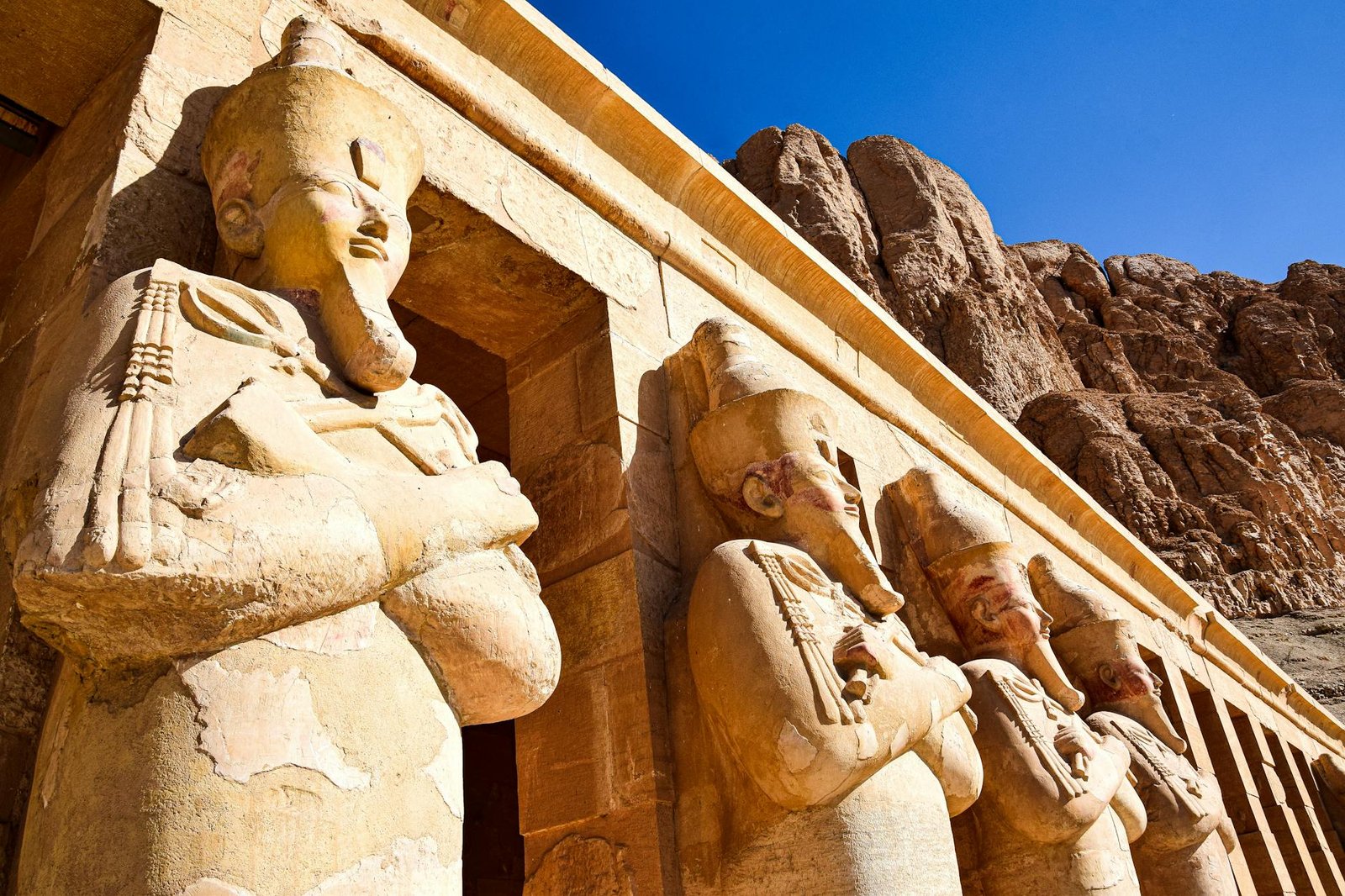
A short drive from the Valley's entrance, cut into the same golden cliff face at Deir el-Bahari, sits the mortuary temple of Hatshepsut — one of only a handful of women to rule Egypt as pharaoh in her own right, rather than as a regent or consort. Her temple is unlike anything else on the West Bank: three vast colonnaded terraces rising in stacked horizontal lines against the rock, so precisely aligned with the cliff behind it that from a distance the building and the mountain seem to belong to the same geological event.
After Hatshepsut's death, her stepson and successor Thutmose III ordered much of her imagery and name chiseled out of monuments across Egypt — an act of erasure that nearly worked. It took modern Egyptology piecing together fragments from multiple sites to fully reconstruct her reign. The temple survived largely because of its sheer architectural ambition: too solid, too embedded in the landscape, to be dismantled the way a smaller monument might have been.
Walk Into the Valley Yourself
No drone shot or balloon basket replaces standing inside a 3,000-year-old burial chamber with the original paint still on the walls. These Egypt Sun Travel tours get you through the West Bank tombs and the East Bank temples with a licensed Egyptologist who knows exactly which doorways are worth the climb.
The Colossi of Memnon and the Quieter Side of the West Bank
On the open plain between the river and the Valley, two seated stone giants rise nearly eighteen meters out of the fields, all that remains above ground of what was once the largest mortuary temple complex in Egypt, built for Amenhotep III. Earthquakes, flooding, and millennia of stone-robbing for later construction projects dismantled almost everything else; the colossi themselves stood cracked and partially collapsed for centuries, and ancient Greek and Roman travelers came specifically to hear one of them 'sing' at dawn — a strange whistling sound caused by temperature change in the fractured stone, which stopped once Roman-era repairs sealed the cracks.
Nearby, far fewer visitors make it to the Valley of the Nobles, where the tombs belonged not to kings but to high officials, scribes, and priests. Their walls trade royal religious scenes for something more personal: wine harvests, banquets, servants at work, daily life rendered in paint with an intimacy the royal tombs rarely attempt. The Ramesseum, Ramesses II's own mortuary temple nearby, now stands largely in ruins, its fallen colossal statue believed to have partly inspired Percy Bysshe Shelley's poem 'Ozymandias.'
Crossing the River: Karnak and the Forest of Stone Columns
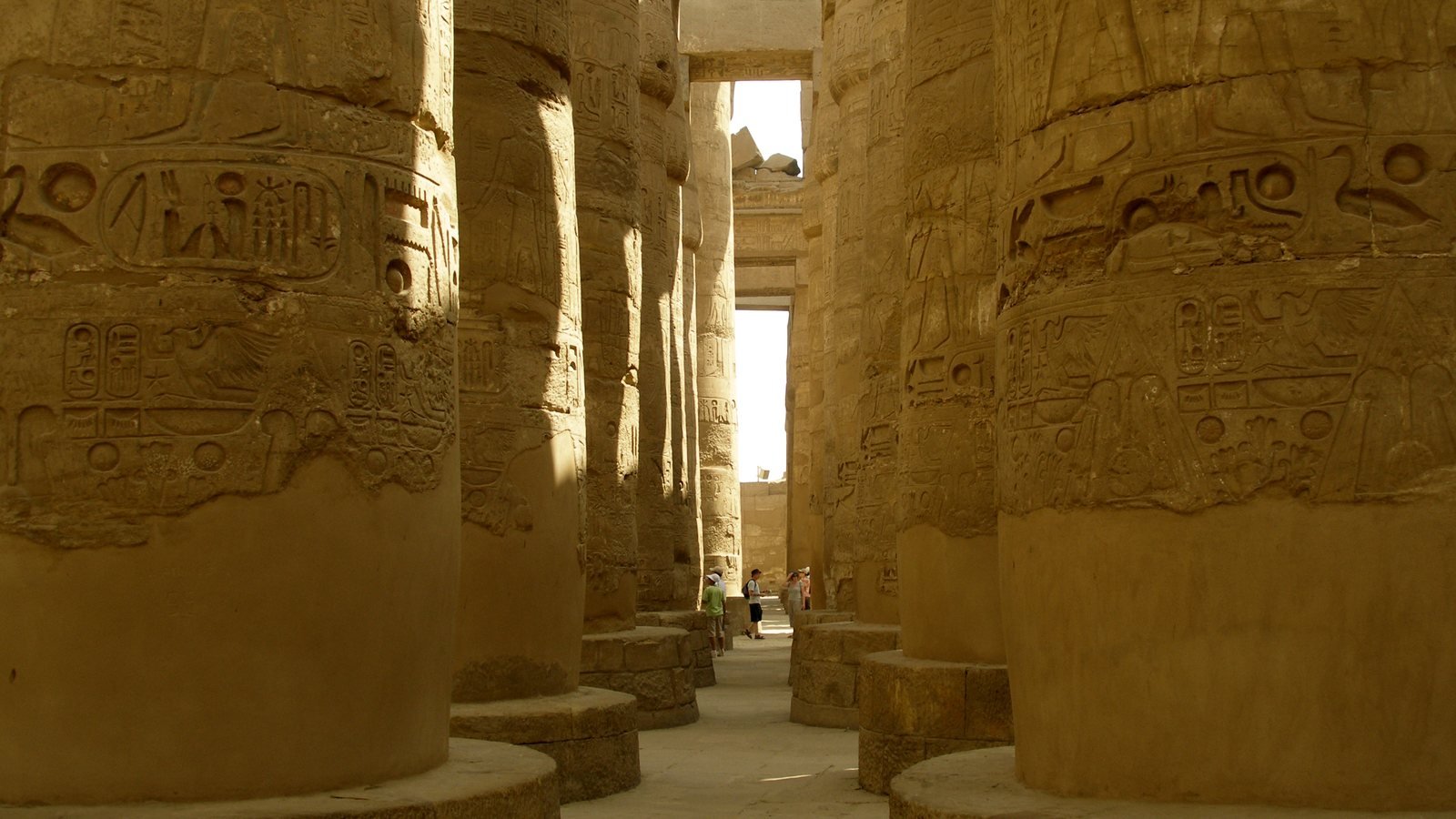
The East Bank of Luxor tells a different half of the same story. Where the West Bank was built for the dead, the East Bank — anchored by Karnak Temple and Luxor Temple — was built for the living gods, in active use for nearly two thousand years and expanded by successive pharaohs each adding their own additions. Karnak's Great Hypostyle Hall is the single most overwhelming space in the entire complex: 134 massive sandstone columns packed into roughly 5,000 square meters, arranged in sixteen rows, the central twelve soaring nearly 21 meters high.
Standing underneath them, the columns are carved to resemble papyrus reeds — a deliberate reference to the primordial marsh from which ancient Egyptians believed the first god emerged at the beginning of creation. Built largely under Seti I and completed by his son Ramesses II around 1300 BCE, the hall was designed to make a visitor feel small on purpose, walking through what was effectively a stone forest built for a god rather than a person.
Two Banks, One River, One Long Conversation With the Past
Luxor is sometimes described as the world's largest open-air museum, and the ground-level version of that claim is the one that actually sticks: a single morning can take you from a sealed, painted burial chamber cut into a cliff to the open colonnades of a temple still standing after three thousand years of continuous use. Few places on earth let you move between the private and the monumental, the hidden and the immense, within the space of an afternoon.
It is also, in a quieter way, a fitting companion to the rest of a trip through Egypt — a reminder that the civilization that built the pyramids at Giza didn't stop evolving, and that some of its most sophisticated engineering and artistry came centuries later, carved not to be seen from a distance, but to be found.